Family Office Case Studies
A sophisticated European family office, with a €250 million portfolio, identified a strategic need to rebalance its asset allocation. The portfolio was heavily weighted towards Venture Capital (VC), an asset class that had performed exceptionally well but was now viewed as carrying excessive risk given the family's long-term wealth preservation goals. The objective was to reduce the VC allocation from 50% to 30% and increase the Private Equity (PE) allocation from 30% to 50%. This case study demonstrates how the family office used a Net Asset Value (NAV) facility to execute this shift immediately, bridging the liquidity gap while waiting for its illiquid VC stakes to mature.
The primary obstacle to the rebalancing strategy was the illiquid nature of the family’s €125 million in VC investments. A forced sale of these Limited Partner (LP) stakes on the secondary market would likely result in a significant discount to their fair value, destroying wealth. However, waiting for the VC funds to naturally distribute capital (DPI) could take several years, causing the family office to miss out on attractive PE investment opportunities in the current market. The family needed a way to access capital immediately to begin investing in PE, using the anticipated future VC distributions as the repayment source.
The family office structured a €62.5 million NAV facility, representing a 25% Loan-to-Value (LTV) against its total €250 million portfolio. The facility was structured with a 5-year term and a fixed 11% Payment-in-Kind (PIK) interest rate, providing cost certainty and preserving cash flow by deferring interest payments.
The key to the strategy was the repayment plan. The facility was designed to be paid down over a 3-year period using the distributions from its maturing VC fund investments. Crucially, the family office also retained the option to repay the facility from its other assets (€50 million in a liquid portfolio) if the VC distributions failed to materialize as expected, providing a robust fallback plan.
The €62.5 million in proceeds from the NAV facility were immediately deployed to make new investments in PE funds, kick-starting the rebalancing process. This allowed the family office to de-risk its portfolio by increasing its allocation to the more stable, cash-flow-generative PE asset class without having to sell its VC assets at a discount.
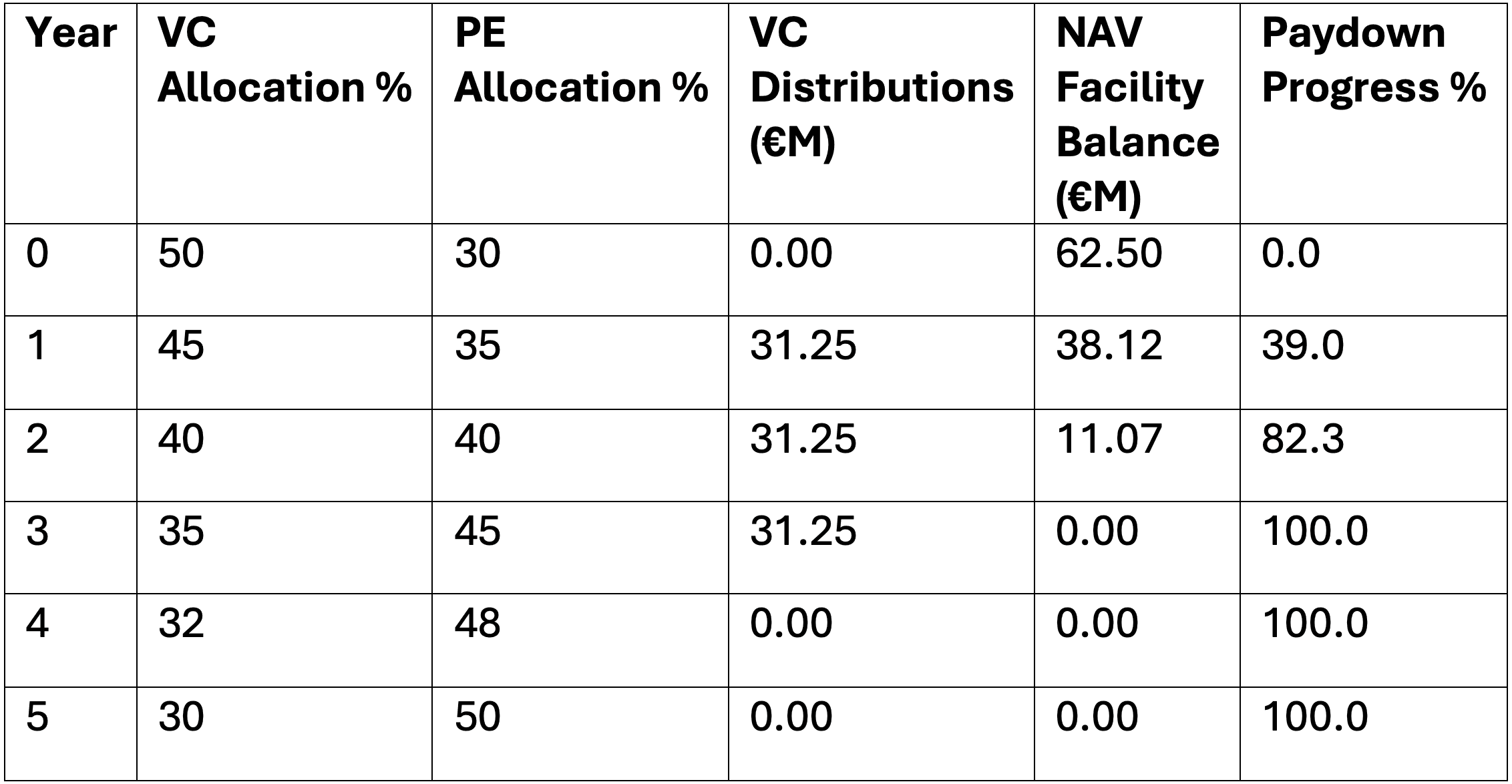
As anticipated, the family’s VC portfolio began generating significant distributions in the following years. These cash inflows were used to aggressively pay down the NAV facility. The combination of the high PIK interest rate and the large, front-loaded repayments meant the facility was fully paid off within the planned 3-year window.
The NAV facility enabled the family office to successfully execute its strategic objective. It immediately bridged the liquidity gap, allowing for a timely shift into PE while avoiding a value-destructive fire sale of its VC assets. The facility was fully repaid within three years, demonstrating the effectiveness of using future fund distributions as a reliable repayment source.
The following table and chart illustrate the rapid paydown of the NAV facility, funded by the maturing VC portfolio: