Family Office Case Studies
A diversified European family office, with a €300 million portfolio balanced between Venture Capital (VC) and Private Equity (PE), faced a sudden liquidity challenge. One of its top-tier VC funds issued a large, sooner-than-expected capital call to seize a rare investment opportunity in a company founded by a multi-unicorn founder.
This case study illustrates how the family office used a conservatively structured Net Asset Value (NAV) facility to meet this unexpected demand without disrupting its long-term investment strategy or being forced to sell assets at an inopportune time.
The family office received a €45 million capital call from its VC fund, due in 30 days. While the family office was confident in the investment, it did not have sufficient unallocated cash to meet such a large, unexpected call. The alternative—selling liquid assets or defaulting on the capital call—was highly unattractive. Defaulting would damage the family's reputation and forfeit a potentially lucrative investment, while a forced sale of other assets could trigger tax liabilities and disrupt the portfolio's strategic allocation.
To address the immediate liquidity need, the family office secured a €45 million NAV facility, representing a very conservative 15% Loan-to-Value (LTV) against its €300 million portfolio. The facility was structured with a 5-year term and a fixed 10% Payment-in-Kind (PIK) interest rate. The low LTV ensured quick approval and favourable terms, while the PIK feature preserved the family's operational cash flow.
The repayment plan was designed to align with the portfolio's natural liquidity cycle. The primary source of repayment was the anticipated cash distributions from the family's €120 million PE portfolio, which was expected to generate significant liquidity over the next three years. As a crucial fallback, the family office had the option to repay the facility from its €60 million portfolio of other liquid assets if the PE distributions (DPI) did not materialize as planned.
The €45 million from the NAV facility was drawn down to meet the VC capital call, allowing the family office to participate in the high-profile investment opportunity. This action transformed a potential liquidity crisis into a manageable financing plan.
The family office's strategy was built on multiple layers of risk mitigation:
1 Immediate Liquidity: The NAV facility provided the instant cash needed to meet the capital call.
2 Primary Repayment Source: The anticipated distributions from the PE portfolio were earmarked for repaying the facility.
3 Secondary Repayment Source: The portfolio of other liquid assets served as a reliable fallback, ensuring the facility could be repaid even in a worst-case scenario where PE distributions were delayed.
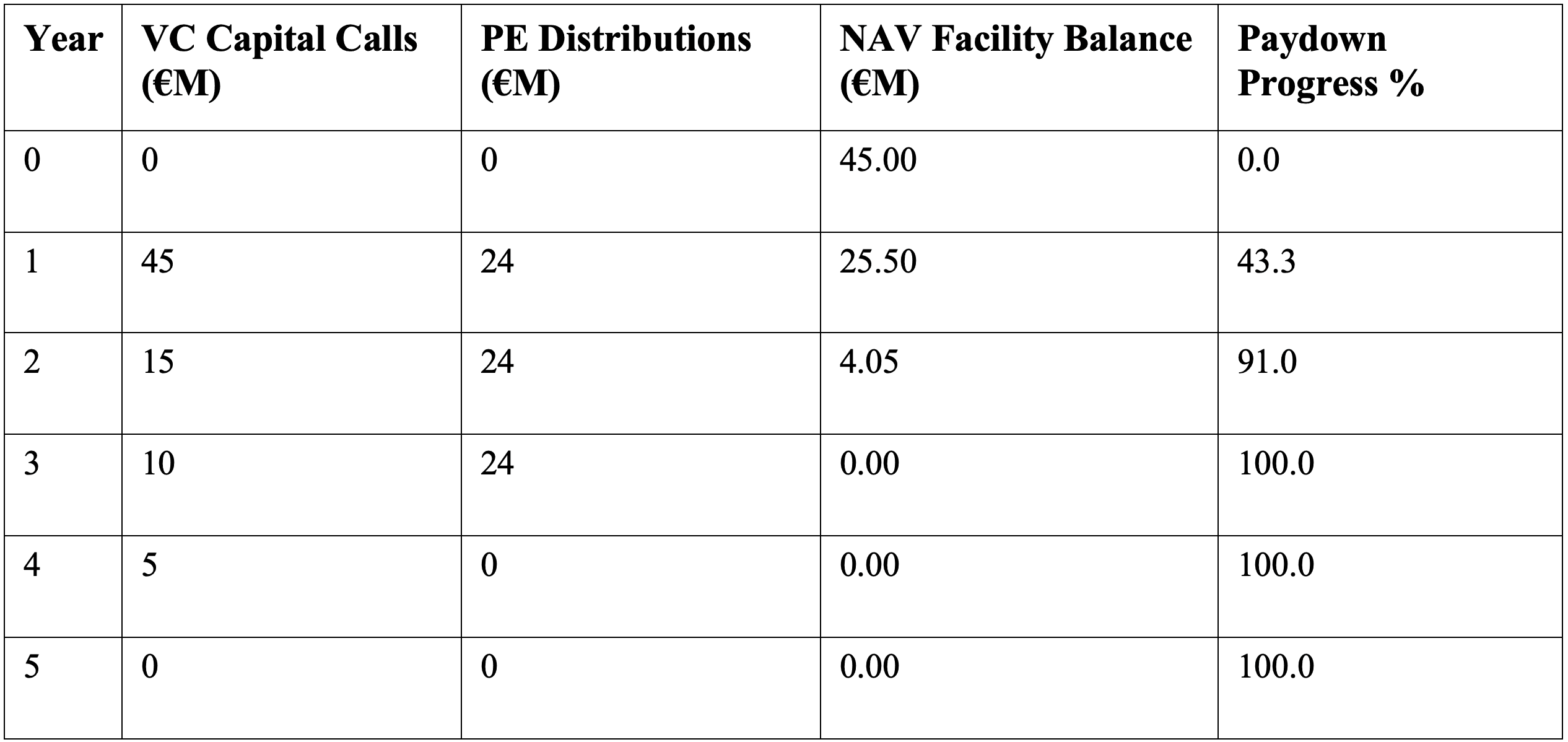
As expected, the PE portfolio began generating distributions, which were used to service and pay down the NAV facility. The loan was fully repaid within the planned 3-year window.
The NAV facility proved to be an essential tool for managing the unexpected capital call. It provided the necessary liquidity at a critical moment, allowing the family office to uphold its commitment to its VC fund and participate in a valuable investment. The multi-layered repayment plan provided the family with confidence and flexibility, ensuring the facility could be repaid without undue stress on the portfolio.
The following table and chart illustrate how the NAV facility bridged the liquidity gap and was subsequently repaid by the PE distributions: