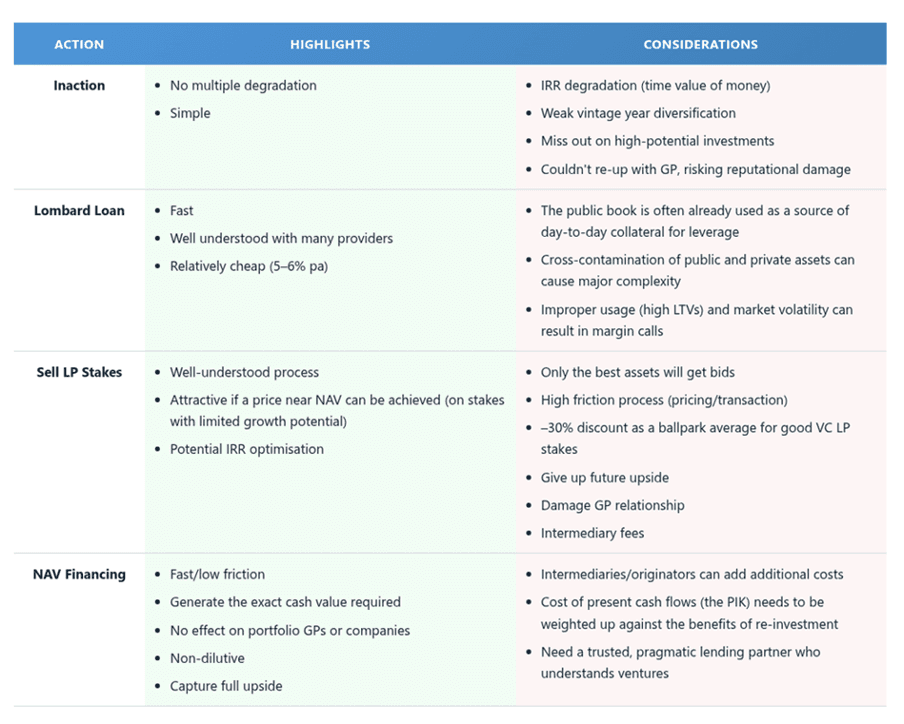
Family Office Case Studies
Family Invest has identified an intermediary (charging a 2% success fee on the sale price) to sell a portion of the portfolio. They decide to try this process.
What happened? Time and expense
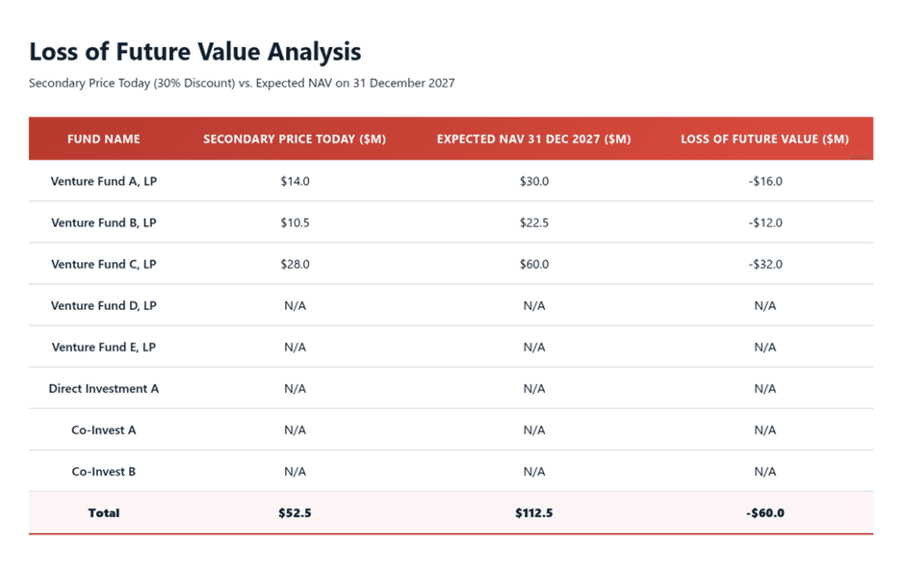
New-vintage LP interests attract no bids, while many others attract bids at a 50% discount to NAV. The most valuable/mature stakes in A, B, and C attracted bids of -30% versus the current NAV.
The process took 5 months to close, with meaningful interaction with the GP, the intermediary, and the buying LP. Selling these stakes generated $52.5m ($50.9m net), enabling the family office to make new investments.
The real cost of Secondaries
The main issue here is that the LP stakes that were sold are expected to grow sharply over the next two years. The chart below shows that the real cost is the loss of future value (calculated as the Secondary Price Today minus the expected NAV on 31 December 2027).
Family Invest works with Nodem to generate $40m in cash within 5 weeks by securing a NAV loan against $215m of residual portfolio value (an 18.6% LTV NAV facility). They generate liquidity for accretive investments without the need to sell.
The headline cost of the NAV facility is a 10% pa PIK. Payment-in-Kind (PIK) is interest that isn't paid in cash but is added to the principal balance (aligned with natural distributions).
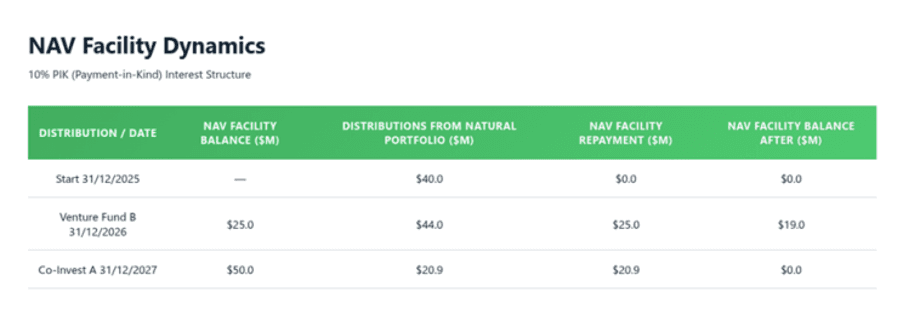
The NAV facility waterfall
1. Family Invest receive from the NAV facility.
2. $25m of the NAV facility is repaid from Venture Fund B distributions on 31st December 2026. This $25m is paid after a full 12 months of PIK accrual. Resulting in a post NAV balance of $19m.
3. The outstanding NAV loan is then fully repaid on 31st December 2027. Paid after another 12 months of PIK have accrued on the $19m balance.
Decision-Making Matrix